- calendar_today August 18, 2025
The Buggy Reality of Nvidia’s G-Assist Experiment.
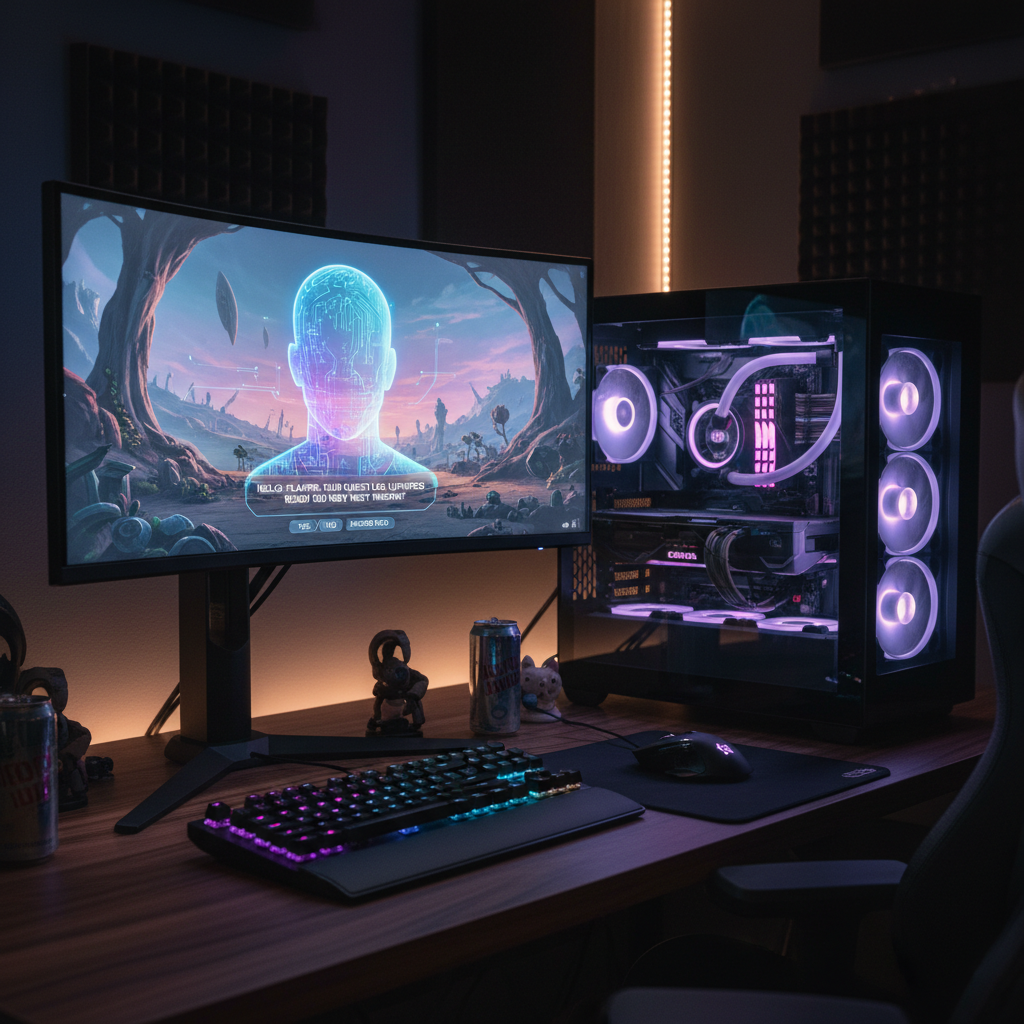
Nvidia continues to lead in graphics technology while investigating how AI advancements could transform gaming experiences. Although Nvidia GPUs are mainly recognized for their advanced visual capabilities, they have now launched an experimental AI feature named G-Assist. This locally-run tool focuses on PC optimization while providing new gameplay enhancements that show how future human-computer interactions might develop.
Users can access this technology through the Nvidia desktop application as an on-screen overlay to interact with an AI assistant using text or voice commands, which enhances control beyond traditional system monitoring and creates new ways for gamers to interact with their devices.
G-Assist’s Core Functionalities
G-Assist delivers a variety of innovative features that help simplify the gaming experience. Users can ask broad questions like “How does DLSS Frame Generation work?” and receive informative, AI-driven responses. The AI possesses capabilities to handle precise system-level configurations. Once G-Assist is enabled, gamers gain access to real-time system operation analysis through dynamically created charts that display performance data.
The AI system can be directed to modify game settings and enable or disable features to deliver enhanced automated optimization capabilities. G-Assist enables users to achieve GPU overclocking while also projecting potential performance gains which streamlines a typically complicated process.
The public release exhibits promising features, yet it lacks the deeper integration shown in prior demonstrations where G-Assist provided in-game assistance. This more immersive level of integration is presently limited to a small selection of titles, with Ark: Survival Evolved being a key example. Nvidia expanded G-Assist’s potential capabilities by introducing support for third-party plug-ins.
The AI assistant establishes connections with peripherals from brands such as Logitech G, Corsair, MSI, and Nanoleaf, which allows dynamic thermal profile adjustments and LED synchronization while expanding AI control beyond basic system configurations.
System Requirements and Performance Analysis
Nvidia wants to showcase desktop systems powered by dedicated GPUs as powerful AI processing machines alongside the rise of “AI laptops.” Nvidia’s G-Assist operates directly on the user’s computer using the processing capabilities of the GeForce RTX graphics card unlike AI tools which function in the cloud.
Nvidia states that G-Assist uses a small language model (SLM) which is optimized for local processing to provide quicker responses while improving user privacy.
The text installation demands 3GB of storage while voice control needs an additional 3.5GB to bring the total storage requirement to 6.5GB. G-Assist needs a GeForce RTX 30 series GPU or newer with a minimum of 12GB VRAM. The system performance depends on GPU capabilities while future updates will include support for laptop GPUs.
Running G-Assist locally on the GPU brings both positive features and significant challenges. Running operations locally results in improved privacy and minimized latency, which enables faster user interactions. However, it also introduces performance considerations. Testing with an RTX 4070 showed that G-Assist interactions caused the GPU utilization to rise noticeably. AI response generation during inference places computational demands on systems, which can affect running tasks, especially high-performance games.
Frame rates in Baldur’s Gate 3 with maximum settings fell by around 20% while G-Assist was processing. G-Assist creates additional performance constraints that could intensify existing bottlenecks in systems already operating at maximum capacity. G-Assist functions effectively when not running demanding games, but requires a powerful GPU during consistent heavy usage.
Looking Ahead: The Future of AI in Gaming
The experimental stage of G-Assist manifests through its intermittent performance delays and existing software issues. Manual adjustment of system and game settings offers the best practical solution for most users during this development phase. G-Assist marks an important advancement in utilizing AI processing capabilities in gaming PCs, which points to a future where GPUs will deliver broader interactive experiences.
Advancements in GPU technology are paving the way for seamless integration between demanding games and sophisticated AI models. The current version of Nvidia’s G-Assist offers a fascinating preview of AI-based gaming capabilities that continue to develop.