
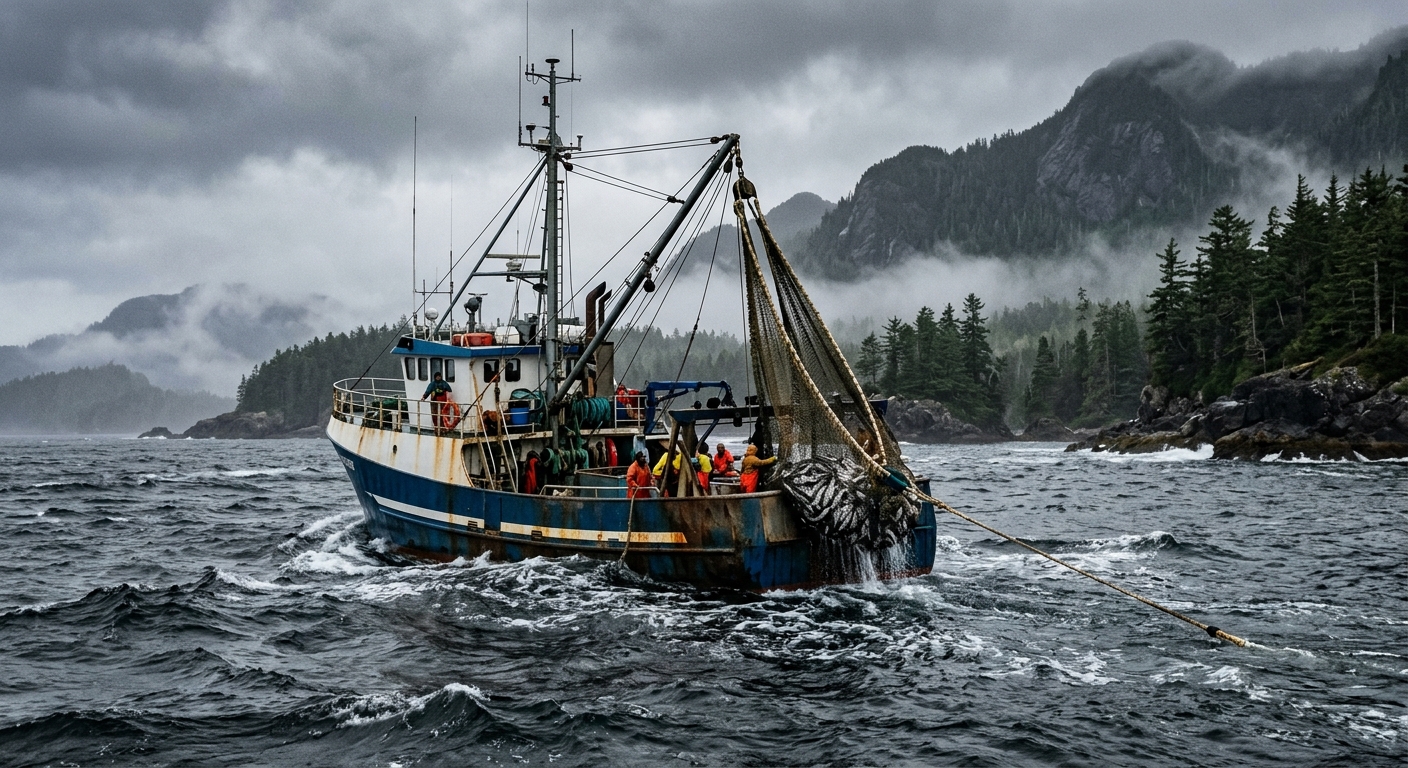
AI-generated illustration; not a photograph of the reported event.
- calendar_today October 9, 2026
Alaska Pollock Fishery at the Center of Growing Controversy
The Alaska pollock fishery, a global industry whose catch is found in North American food staples like fish sticks and McDonald's Filet-O-Fish, has become a flashpoint in debates over industrial fishing practices. The use of trawling nets, which target pollock but catch other marine species (known as bycatch), is fueling political, cultural, and environmental disputes, particularly in Alaska.
Bycatch and Its Role in the Salmon Decline
Bycatch constitutes around two percent of the total pollock catch, a figure that translates to hundreds of thousands of salmon annually due to the massive scale of the fishery. Over the past decade, Bering Sea pollock trawlers caught an average of approximately 18,000 Chinook and 288,000 other salmon per year, mostly chum. These numbers are particularly contentious as salmon runs have declined across western Alaska, impacting dozens of Indigenous communities who have historically depended on salmon.
While scientists attribute much of the salmon decline to warming waters and shifting ocean conditions, some critics argue that bycatch is a manageable source of mortality and should be minimized, especially when salmon populations are low.
Efforts to Reduce Salmon Bycatch During Bering Sea Fishing
Onboard pollock trawlers like the F/V Progress, captains such as Maverick Blake actively seek to avoid salmon bycatch, sometimes burning additional fuel to find fishing grounds with fewer salmon. State-of-the-art monitoring, communication among vessels, and salmon excluder devices are used to limit bycatch. Every salmon caught is counted, and the industry is regarded by proponents as one of the best-managed fisheries in the world.
Nonetheless, small-scale fishers, including those targeting halibut and crab, continue to express concern about the overall amount of bycatch, which in 2025 amounted to 44,000 metric tonnes — equivalent to 100 fully loaded Boeing 747-8s.
Impact on Indigenous Communities Along the Yukon River
Restrictions on salmon fishing have had profound cultural and practical effects on villages along the Yukon River, where Indigenous families like that of Brooke Woods, a commissioner for the Yukon River Inter-Tribal Fish Commission, have faced unprecedented salmon harvest bans. The seven-year moratorium on Chinook fishing, along with other closures, is intended to allow salmon populations to recover, but it has left communities with limited access to traditional food sources and threatened cultural heritage.
Brooke Woods described the sense of loss as families are unable to teach or partake in ancestral fishing practices. Access to grocery stores is limited in rural areas like Rampart, intensifying reliance on fishing.
Genetics and Regional Salmon Bycatch
Analysis by the Bristol Bay Science and Research Institute and NOAA has shown that most chum salmon bycatch is not of western Alaska origin. However, even a relatively small share can result in tens of thousands of western Alaska salmon being caught. For instance, nine percent of the chum bycatch in 2021 amounted to over 51,000 western Alaska salmon.
In response to advocacy and testimony, the North Pacific Fishery Management Council recommended a cap of 45,000 western Alaska chum bycatch — a figure some stakeholders believe remains too high. The pollock industry continues to provide thousands of jobs and generates substantial revenue, but critics note that much of the economic benefit leaves the state.
Broader Calls for Reform and Political Action
The debate over the alaska pollock fishery and pollock trawling has become a prominent topic in state politics, with calls from across the political spectrum for stricter regulations. Gubernatorial candidates have campaigned on reforming the composition of the North Pacific council, which oversees trawl fishing, to benefit local conservation interests. In the U.S. Senate, competing proposals include restricting factory trawlers and reducing bycatch.
The controversy also extends to concerns about marine habitat impact, as pelagic trawls, though designed to fish above the seafloor, often contact it, disturbing habitats for species like crabs and basket stars. Critics argue that existing marine conservation areas are undermined by allowing midwater trawls in those regions.
With ongoing tension between sustaining a major industrial fishery and protecting salmon populations and marine habitats, the future of Alaska's pollock fishery remains a subject of heated debate among fishers, Indigenous communities, and policymakers.
Source: cbc.ca.


