- calendar_today August 7, 2025
.
Ukrainian President Volodymyr Zelenskyy said Monday he had a “good” conversation with U.S. President Donald Trump on the question of security guarantees for Ukraine, as the war with Russia enters its fourth year.
“I had a good conversation with President Trump on the question of security guarantees for Ukraine. It is important to stress: security guarantees remain at the center of Ukraine’s survival and our future independence,” Zelenskyy said.
Speaking at the White House alongside Trump and European leaders, Zelenskyy did not provide further detail on how the United States or its European allies could credibly guarantee Ukraine’s security against Russia. “The first one is security guarantees. And we are very happy with President [Trump], that all the leaders are here, and security in Ukraine depends on the United States and European countries,” Zelenskyy said. The U.S. and the decision of the United States are very important signals. For us, it is very important,” he added.
Trump, for his part, also emphasized security but said that it must be Europe’s responsibility. He also echoed his previous statements about needing to discuss territory before the conflict can be resolved. “We’re going to help them, and we’re going to make it very secure. We also need to discuss the possible exchanges of territory, taking into consideration the current line of contact. That means the war zone, the war line center,” he said.
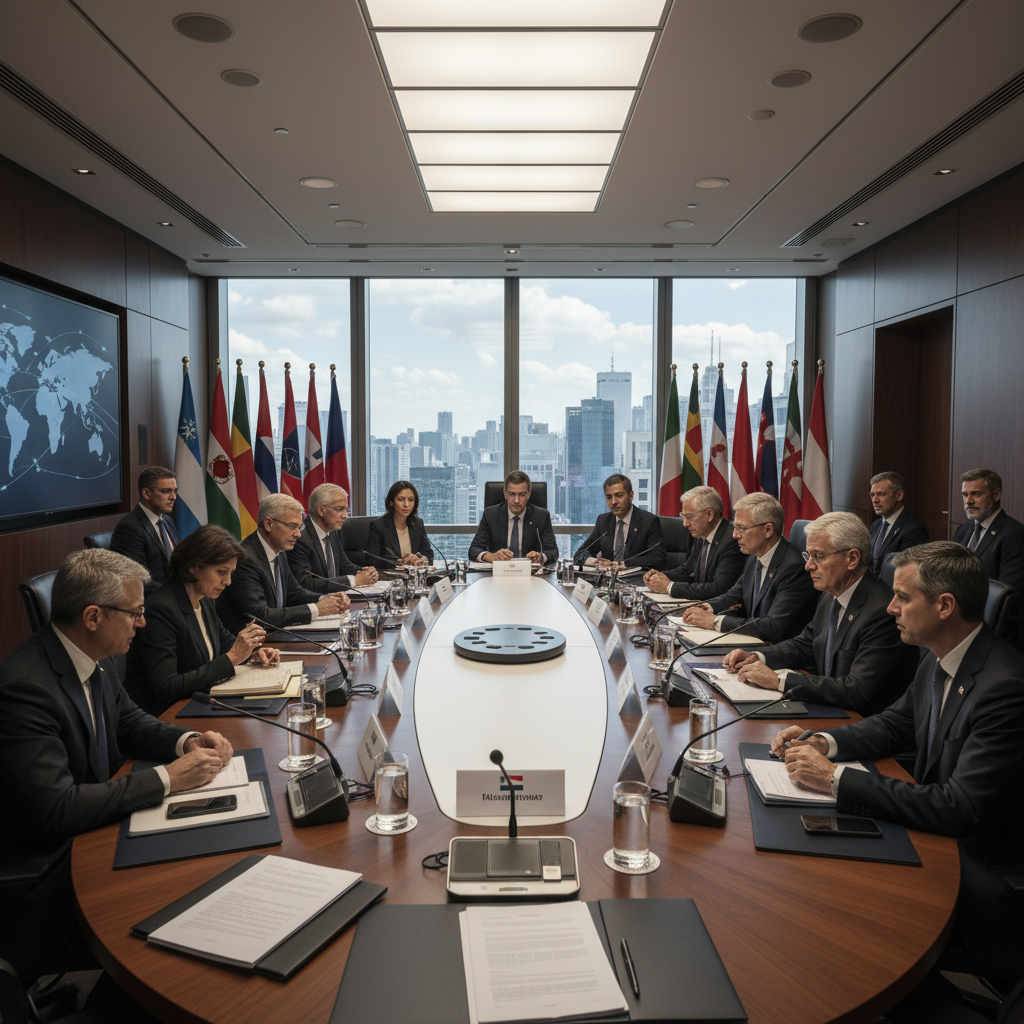
The White House meeting between Trump, Zelenskyy, and their European counterparts highlighted stark differences in Western capitals over how best to support Ukraine while still seeking a negotiated peace. Trump has been the most vocal about the possibility of Ukraine making territorial concessions to Russia, while Zelenskyy has repeatedly said that Ukraine will never cede its sovereignty or international borders.
Ukraine War Talks Highlight U.S.–Europe Strategic Differences
Ukrainian President Volodymyr Zelenskyy said Monday he had a “good” conversation with U.S. President Donald Trump on the question of security guarantees for Ukraine, as the war with Russia enters its fourth year.
“I had a good conversation with President Trump on the question of security guarantees for Ukraine. It is important to stress: security guarantees remain at the center of Ukraine’s survival and our future independence,” Zelenskyy said.
Speaking at the White House alongside Trump and European leaders, Zelenskyy did not provide further detail on how the United States or its European allies could credibly guarantee Ukraine’s security against Russia. “The first one is security guarantees. And we are very happy with President [Trump], that all the leaders are here, and security in Ukraine depends on the United States and European countries,” Zelenskyy said. The U.S. and the decision of the United States are very important signals. For us, it is very important,” he added.
Trump, for his part, also emphasized security but said that it must be Europe’s responsibility. He also echoed his previous statements about needing to discuss territory before the conflict can be resolved. “We’re going to help them, and we’re going to make it very secure. We also need to discuss the possible exchanges of territory, taking into consideration the current line of contact. That means the war zone, the war line center,” he said.
Sanctions, Ceasefire Debate, and the NATO Question
Leaders in Washington spoke of guarantees while U.S. lawmakers ratcheted up calls for economic pressure on Moscow and its trading partners. Senator Lindsey Graham, R-S.C., said that the Trump administration should be prepared to target the financial system of countries that continue to buy Russian oil. He is co-sponsoring a bill that would give Trump the authority to impose tariffs of up to 500 percent on “any country that continues to do business with Russia.”
“My advice to President Trump and [Secretary of State Marco Rubio] is, you’ve got to convince Putin that if this war doesn’t end justly and honorably with Ukraine making concessions also, we’re going to destroy the Russian economy,” Graham told Fox News on Monday. He singled out China as a key leverage point for Trump in pressuring Russian President Vladimir Putin. “The second most important person on the planet to end this war is President Xi in China,” Graham said. “If President Xi says, ‘Hey, Mr. Putin, let’s not do this, our economy’s gonna be destroyed.’ If he said that to Trump, I’ll bet Trump would end the war tomorrow.”
Trump has already demonstrated a willingness to wield tariffs as a blunt tool in the Russia-Ukraine conflict, imposing a 50 percent tariff on India in August in part over that country’s purchases of Russian oil. Graham implied that similar pressure on China could turn the tide in the conflict.
Also in attendance at the White House talks was Finnish President Alexander Stubb, who was recently inaugurated in March 2024. Stubb, who has been openly skeptical about Russian President Vladimir Putin’s willingness to respect a ceasefire, has repeatedly noted his country’s experience with Russia, which shares an 800-mile border with Finland. “If I look at the silver lining of where we stand right now, we found a solution in 1944, and I’m sure that we’ll be able to find a solution in 2025 to end Russia’s war of aggression,” Stubb said. A close confidante of Trump’s in Europe, Stubb is one of the few Western leaders the former president has had face-to-face meetings with and been photographed with frequently without criticism.
The divergent views between Zelenskyy’s request for longer-term Western security guarantees and Trump’s demand for territorial concessions and the relinquishing of Crimea underscored how divided Washington and Europe remain on the question of how best to end the war. With new EU sanctions in the works, rising threats of tariffs, and continued battles in Ukraine, the path to peace will likely continue to be squeezed by the demands of compromise and solidarity.