- calendar_today August 14, 2025
.
US electric vehicle adoption is about to enter a new period of doubt. After a year of stable monthly growth, US EV sales are starting to decline. For some automakers like Genesis and Volvo, US consumers have already turned their backs on the brand’s electric vehicles, leading both companies to rethink their product lineup. At the same time, the current US administration has moved to slash subsidies and vehicle pollution standards. As a result, there are fewer carrots coming from Washington. But according to industry analysts, the biggest EV adoption challenge may be hiding in plain sight in the form of US garages.
EV Charging: The Parking Lot Edition
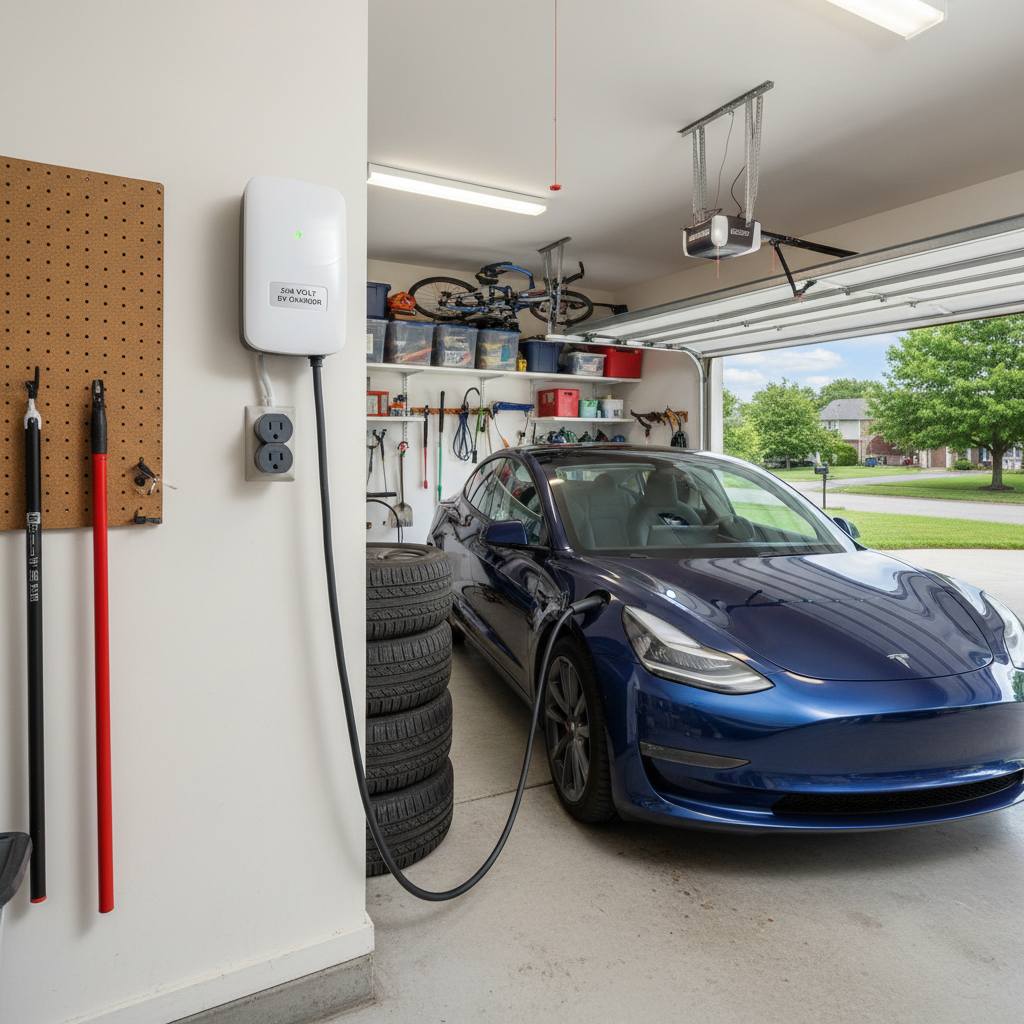
Surveys have long found that charging availability and access concerns are the number one barrier to EV ownership. A new Telemetry market research report led by VP Sam Abuelsamid offers new detail on this challenge. In particular, one often-overlooked aspect of the home charging puzzle is what Americans do in their garages.
Although much media attention is currently focused on EV fast charging networks, most EV charging occurs at home. Some 80 percent of all EV charging, including Tesla Superchargers, is still done with AC power. And data from the National Renewable Energy Laboratory (NREL) has found that this charging is concentrated at single-family homes. In total, 42 percent of US homeowners already have the ability to park next to an outlet that can support 240-volt (level 2) charging.
If homeowners defrosted space in their garages and parked in a way that enabled charging, this figure could double or more to 68 percent of US homes. “90 percent of all houses can add a 240 V outlet near where cars could be parked. Parking behavior, namely whether homeowners use a private garage for parking or storage, will likely become a key factor in EV adoption,” Abuelsamid notes.
Parking EVs in the garage could boost the number of US homes with the ability to charge an EV from 31 million to more than 50 million. Adding in houses where wiring to the garage is possible, the total climbs to more than 72 million. This estimate is higher than even Telemetry’s high-end 2035 EV sales projections of 33–57 million vehicles. Of course, having the capacity to support charging in theory does not mean that the necessary upgrades have already been made in practice.
The same NREL study found that 33.9 million homes could not support a level 2 charger with their current electrical panels. These chargers, which can support overnight charging of an EV battery, typically require at least 30 amps of power and may require new wiring, panel upgrades, or even entirely new service panels. For many homeowners, these upgrades can cost several thousand dollars or more, undermining the economics of owning an EV in the first place.
The cost of charging remains one of the main hurdles for US consumers. Total cost of ownership for an EV over three years and 45,000 miles may be lower than for a gasoline-powered vehicle, but the cost of installing a 240-volt charger can more than eat up those savings, especially if the vehicle charger has to be upgraded or if electrical service to the home is insufficient to support the vehicle and charger.
More Challenges on the Way: Apartment Dwellers
The parking challenges are even more acute for the 23 percent of US residents who live in multifamily homes, such as apartments, condos, or townhomes. In most cases, individual EV drivers in these situations do not have the authority to install chargers themselves. In this situation, EV drivers must get permission from landlords, management companies, or condo co-op boards before proceeding. Many of these groups will decline, citing costs, aesthetics, construction difficulties, and the fact that many renters do not stay at a property for three years or more.
The costs are also substantially higher. Installing two shared level 2 chargers in an apartment co-op or condo complex, for example, may first require an entire electrical panel upgrade to accommodate the charging demand. This work can cost millions of dollars. Wiring chargers into distant parking spaces adds to the expense and complexity. Owners of these multifamily dwellings may or may not be eligible for local or utility subsidies for the work, unlike the majority of homeowners. In any case, the owners are more likely to pass costs along to residents, making the numbers even more difficult to justify for apartment or condo boards.
There are around one million EV drivers living in multifamily homes today. Yet of these, just 11 percent park next to an outlet that could support EV charging. In an attempt to spur EV-ready homes in this segment, some states have passed legislation requiring 20–25 percent of new multifamily parking spaces be EV-ready. However, even under this legislation, Telemetry forecasts only 6.7 million to 11.4 million charging-capable spaces will be available in multifamily dwellings by 2035. This level will be well short of demand, which is likely to exceed 14 million US drivers in the coming decade.
Public Charging Networks Must Keep Pace
Home charging will only get EV drivers so far. Telemetry’s estimates show that 11.7 million to 14.3 million EV drivers who own single-family homes will still need public charging in 2035. Another 7.8 million to 8.1 million EV drivers living in multifamily homes will also use public chargers. The need for public chargers requires that utilities and state and federal authorities allocate sufficient resources for installation.
In total, between 523,000 and 586,000 DC fast chargers would be required to meet the 2035 demand across the US. But this growth comes with its own challenges. Utility companies are already coming under pressure to provide resources for new AI data centers and their own demand for new generation and distribution resources to support large-scale charger sites.
The situation has become so crowded in the Lone Star State that power grid operators in Texas have moved to block the construction of DC fast chargers along major highways such as I-35. Even along less-traveled routes such as I-40, companies such as EVgo are seeking permits for 2,400 chargers a year. The push to build as much DC fast charging as possible to meet the demand for high-speed travel on EVs is leading to a future capacity crunch on the power grid.
The bright spot in the current situation is that Telemetry data suggests that under 1 million of the 72 million or so US homes with potential EV charging capability have fully installed a 240-volt charger and that even in these houses, the chargers are often not in use. This data suggests that millions of US homes have both the space and ability to support EV charging but need the motivation. Still, as the NREL data shows, millions of homes will still need to be brought up to speed on wiring. And that is not even to mention the need to reduce clutter in the average US garage.
The challenges do not end there. While many EV owners in the current market are multimodal households with multiple cars and parking spaces, a growing number of them are single-car homes that will rely more heavily on public charging. At the same time, a large proportion of current drivers, including those in multifamily homes, may not have access to EV charging in the first place. After the first build-out of public chargers, the task of creating sufficient public charging to meet the inevitable demand from current and future EV drivers may be overwhelming for utility companies. This prospect has become dire enough that state lawmakers in Pennsylvania have moved to address the problem with direct legislation.
Given these multiple barriers, US EV sales and adoption rates are likely to disappoint automakers over the coming months and years. Consumers will remain concerned about EV range until significant numbers of fast-charging stations are completed. At the same time, building charging infrastructure across the US will become an even more challenging and lengthy process. That problem is especially acute in multifamily and apartment homes, where EV owners are least likely to be able to charge at home.