- calendar_today August 17, 2025
President Trump was holding a press conference ostensibly about a European Union trade deal when he began what has become a familiar riff for him, on renewable energy. Wind turbines, he said, were a “con job,” and one of the harms they cause is driving whales “loco.” In addition to torturing marine mammals, he continued, windmills (he often conflates them with wind turbines) kill birds and may even be unsafe for people to live near.
At first glance, this may appear to be another example of a president spouting misinformation for headlines and clips. But beyond Trump’s trademark histrionics lies a complex web of conspiracy theories and historical patterns that surround renewable energy, and wind power in particular. These range from a powerful fossil fuel lobby that sees clean energy as a threat to vested interests, to deep cultural currents that regard changes to the energy system as a profound and unsettling loss of control. Trump is, in many ways, articulating long-running themes about the political challenges to decarbonization.
Windmills and Witches
Trump is fond of using the term windmills to describe wind turbines, even though they are quite different in design, scale, and purpose. (Wind turbines are specifically engineered to generate electricity, whereas a windmill is a broader term that generally means a machine with blades powered by the wind.) Windmills may have become a shorthand term for wind turbines in certain far-right circles, but the conspiracy theories go back much further.
Take, for example, a panic that erupted in the 19th century over the safety of the telephone. Doctors claimed it could spread diseases from person to person. Calls for regulation became a moral panic, with much of the anti-telephone rhetoric centering on fears that women and children were most at risk. The controversy was short-lived, and it did not stop the spread of telephones. But the concerns about losing control of a developing technology can be read as a harbinger of today’s anxieties over renewable energy.
The same is true for a phenomenon that academic research on misinformation has identified as a deep-seated worldview of those who are actively hostile to climate action and clean energy. The data indicate that these attitudes run far deeper than can be fixed by fact-checking or gentle attempts at persuasion. Once such a narrative has taken root in a person’s view of the world, it is resistant to correction.
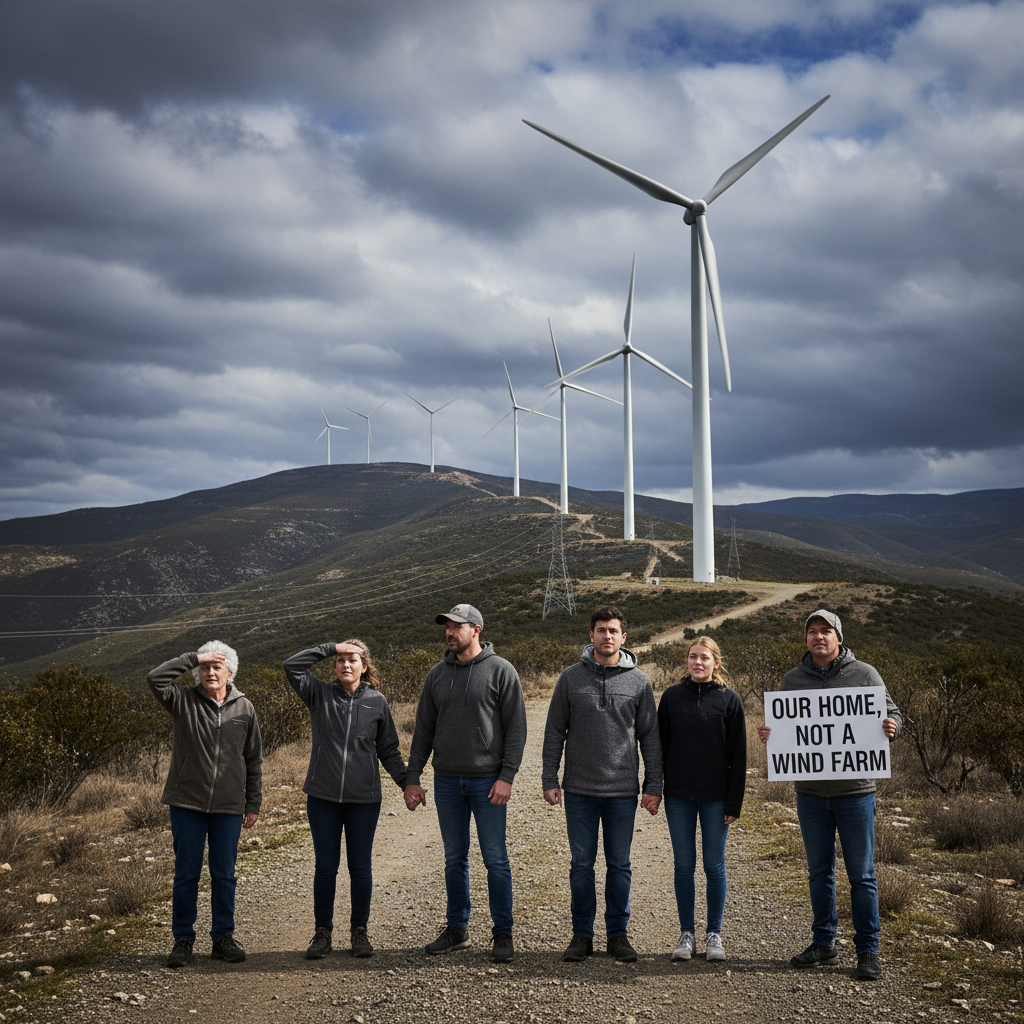
What’s more, these sentiments often carry a subtle, and at times explicit, element of identity politics, wrapped up in the symbolism of wind farms as a way of life being taken away. On one side are the turbines, and on the other are the people. Trump wields this contrast repeatedly, and knowingly: “We must protect our incredible country from windmills,” he tweeted on Jan. 21. The question for clean energy advocates is how to address an energy transition that is also a cultural and identity shift for many people.
The Origins and Growth of Wind Turbine Conspiracies
Warnings from climate scientists have been with us for decades, since at least the 1950s when scientists first understood the potential for CO₂ emissions to cause major and relatively near-term environmental disruption. But for much of the early years of the renewable energy revolution, public arguments for wind, solar, and other forms of clean energy were couched in the language of power and an effort to break the monopoly of fossil fuel giants such as Exxon Mobil, Shell, and BP. In that context, fossil fuels were cast as having something to lose from a transition to renewables.
The Simpsons episode may have been a prescient warning about the coming renewable revolution.
Cultural depictions of that battle are everywhere in popular culture, from Wall Street to Erin Brockovich. One of the most obvious ones is in an episode of The Simpsons, where the megalomaniac industrialist Mr. Burns constructs a tower to block out the sun, so that he can force the townsfolk of Springfield to buy his nuclear power. The cartoon narrative was a satirical exaggeration, but a real-life fear that fossil fuel interests would try to slow renewable deployment did soon materialize.
The proof was in the work of a group set up by then–Australian Prime Minister John Howard in 2004: the Low Emissions Technology Advisory Group, a coalition of fossil fuel industry executives. The group was charged with finding ways to “reduce the pace of growth in renewable energy to help ensure that clean coal, oil and gas will remain the dominant energy sources,” as the Guardian reported at the time.
The same happened in public perceptions of wind turbines. While a coal mine or nuclear power station is often out of sight and out of mind, wind turbines are very visible, often placed on ridgelines or plains. In some instances, opposition to their placement has gone beyond NIMBYism. Wind turbine syndrome, a “non-disease” according to medical experts, has been widely publicized for years in the U.S. and Europe. It is the supposedly mysterious and debilitating health impacts of living near a wind turbine, despite having no scientific evidence to support it.
The data shows the same to be true of objections to wind farms. For some people, the debate is not about renewable energy, but a lens for how they view the world more generally. Kevin Winter, an environmental researcher at the University of Greifswald, led a study in Germany that surveyed residents about local wind turbine development. What they found was that conspiracy thinking was far and away the most important factor in opposition, far more predictive than age, gender, education, political party, or other factors.