- calendar_today August 15, 2025
Alien DNA, Government Experiments, and Giger’s Monster: Species
Michael Madsen, a fixture of gritty cult classics for over 40 years, passed away last month. His characters were best known for popping up in arthouse crime dramas, such as Reservoir Dogs and Kill Bill, or stylish thrillers like Donnie Brasco, Point Break, and Heat. One of his final roles, as a black ops assassin trying to take down a human-alien hybrid in the science-fiction thriller Species, is now 30 years old, but it’s easy to forget that Madsen was in it.
Species, released June 2, 1995, followed on the heels of a horror boom that still fuels the genre today and a streak of alien paranoia that had studios churning out body-hopping monster movies one after another. Roger Donaldson’s (No Way Out, The Bounty) movie was its strange mix of crime-thriller and soft sci-fi about a half-human, half-alien woman who crosses a path with an agent determined to stop her.
Directed by Roger Donaldson, Species centers on a government experiment that combines human DNA with alien DNA in the hope of replicating an extraterrestrial species on Earth. Dr. Xavier Fitch (Ben Kingsley) leads the project, and what results from the experiment is a half-alien human female named Sil (played by Michelle Williams as a child and Natasha Henstridge as an adult). The government team expected Sil to develop slowly. The goal of the experiment was to create a more manageable and controllable organism. Instead, it adapted and evolved too quickly. Her growth is accelerated, and in three months, she’s the size and looks of a 12-year-old. However, she has violent nightmares and violent urges that point to her not being as docile or controlled as intended. Fitch ultimately decides to destroy the experiment, but when he sends cyanide into her chamber to kill her, Sil fights through the poison and escapes.
Tracking Sil is a job for a team of specialists, which is how Fitch meets Madsen’s Preston Lennox, a hard-boiled mercenary; Dr. Laura Baker (Marg Helgenberger), a molecular biologist; Dr. Stephen Arden (Alfred Molina), an anthropologist; and Dan Smithson (Forest Whitaker), a dark, brooding empath with the ability to read Sil’s thoughts and feelings. Their work takes them from Fitch’s lab to the snowy Pacific Northwest and to Los Angeles, where Sil has learned to be more human and hunts to make a family of her own. Her intelligence and adaptability have made her smarter and wilder at the same time. She’s preyed on people in nightclubs, bars, and homeless encampments—anywhere there might be men to help her propagate.
Species’ Alien Girl
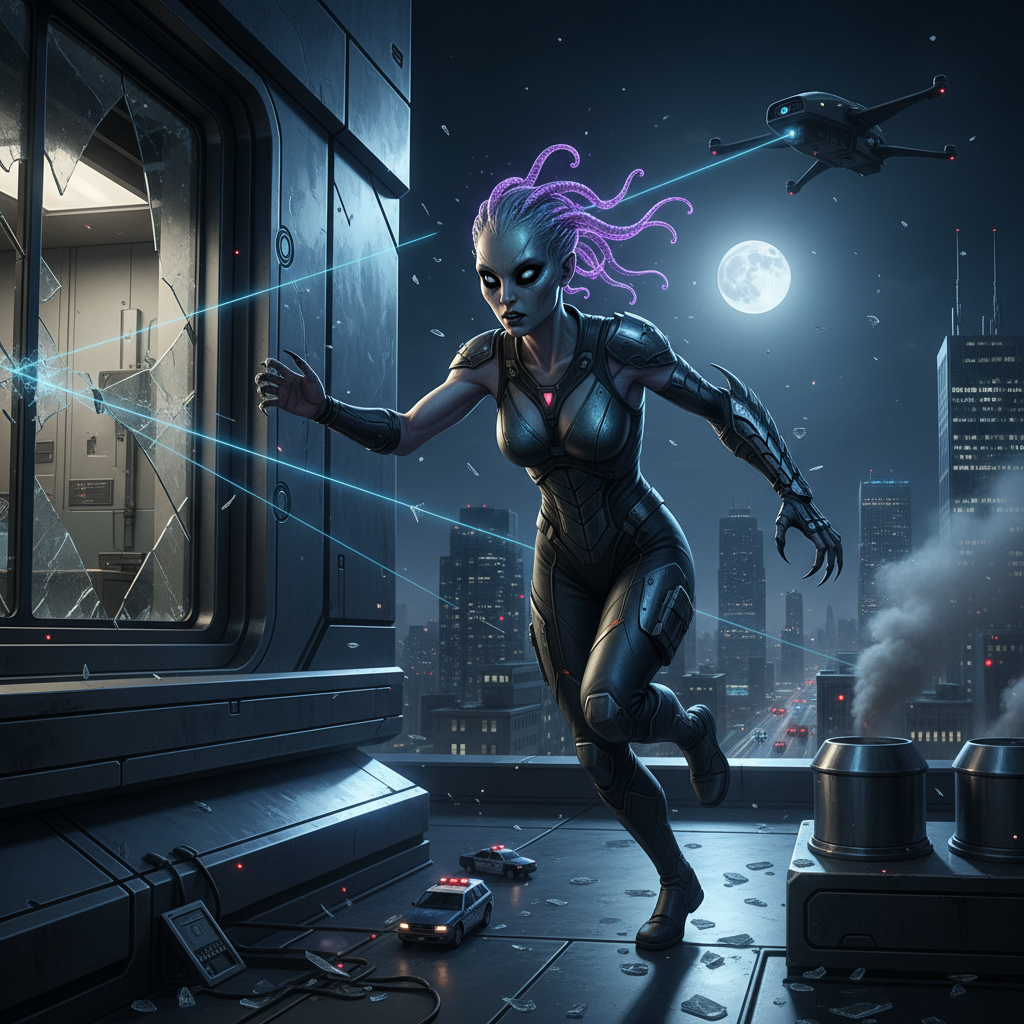
The creature at the center of Species had one of the most talked-about designs of the ’90s. H.R. Giger, the surrealist Swiss artist and designer responsible for the xenomorph in Ridley Scott’s Alien, also designed the exterior of Sil for Species. Giger envisioned his character as “an aesthetic warrior, also sensual and deadly.” He put his spin on the species design, using “translucent material,” giving Sil the “appearance of a glass body but with carbon inside.” He designed several stages of Sil’s alien evolution as she develops from child to adult, but a quick studio turnaround led to a simpler effect: a metamorphosis cocoon in one scene and a more familiar alien maternal body during the final act.
Species wasn’t all Giger’s vision, of course, and despite the film’s commercial success, he took exception to several things on screen. First, he saw too much of Alien in Species. In particular, Giger noted the similarities of Sil’s “punching tongue” to that of the xenomorph in Alien and the birth scene of her baby species in the final act of the film, which he thought was similar to the chestburster scene from Alien.
He also directed a scene change where Sil is killed by a bullet to the head at the climax of the film. The scene was originally a scene of doom that used flame throwers, but Giger shot a re-creation where Sil is burned to a crisp and delivered it to the film’s producers to use as an alternative. In the end, the film used both versions, though the bullet scene is far more prevalent. Giger felt the burning scene was too similar to Alien 3 and Terminator 2.
Species Underwhelmed Critics
Species underperformed among critics. In addition to some clunky dialogue and thin characterizations (Kingsley’s Fitch is no more than an amoral scientist, and Whitaker’s empath mostly stares and says things like “she’s feeling dangerous”), the screenplay, penned by Frank Moira Feldman, just scratches the surface of deeper ideas and themes. The movie flirts with science fiction ideas about bioethics and contact with aliens, but ultimately doesn’t fully explore any of its avenues.
Feldman originally wrote the character of Sil as a direct rebuttal to a 1973 article by Arthur C. Clarke titled “The Liquid Sky.” In the essay, Clarke argued that even if aliens exist, they wouldn’t ever come to Earth in person because interstellar travel is light-years away from even being a reality for the technology of that time. The closest we would come to contact with an alien life form was accidentally encountering an alien spacecraft crash-landing or floating on a deserted planet or moon.
Feldman imagined a different form of contact. What if, he wondered, instead of directly meeting with alien life, the aliens sent a signal containing only the blueprints and design specifications for a self-assembled, organic life form? A single living species with the speed and technology to then produce more of its kind in an almost instantaneous manner. The idea and fear of that kind of accidental alien invasion through no one’s fault becomes Species.
Species was its own style and substance thriller with a canny mix of movie monsters and a nod to the crime-thrillers that Madsen had become known for in the ’90s. The film didn’t reach the levels of creativity or inspiration of Alien, which it most clearly resembled, but it had its charms. Species was also just a film made during a boom time of great style and film design, a wave of moviemaking that set the tone and created new generations of horror and science fiction fans today. And for one of Madsen’s last roles, Species will have to do.
Madsen’s death earlier this month at age 69 was a sad event in Hollywood. His appearances in films like Tarantino’s Reservoir Dogs and Kill Bill made him a perennial fan favorite. He showed up in other memorable movies like Miami Blues, Point Break, and Heat, and in a long career in Hollywood that stretched back more than four decades, his legacy will remain in those roles. It was only fitting that an actor of his caliber had something of an oddball role at the end. Species turns 30 this year, but Madsen’s performance as the rugged, no-nonsense Preston Lennox is a reminder of his iconoclastic style.