- calendar_today August 12, 2025
WHITEHORSE — The night never fully arrives up here. The sky dims but never darkens, and the land glows in shades of silver and pale blue. Against that soft, endless horizon, a screen flickers to life — its light dancing across tundra grass and quiet faces framed by blankets.
In 2025, drive-in theaters have returned to Northern Canada — improbable, beautiful, and deeply human. From Yukon’s river valleys to the snowy coasts of Nunavut, communities are rediscovering the warmth of shared silence, even in places where the air bites and the distances between neighbors stretch for miles.
A Revival Carved from Cold and Courage
The first came in Dawson City, where residents built a screen from aluminum siding left over from mining operations. “It wasn’t fancy, but it worked,” says organizer Harper Nilak. “We wanted something that reminded us we still have each other.”
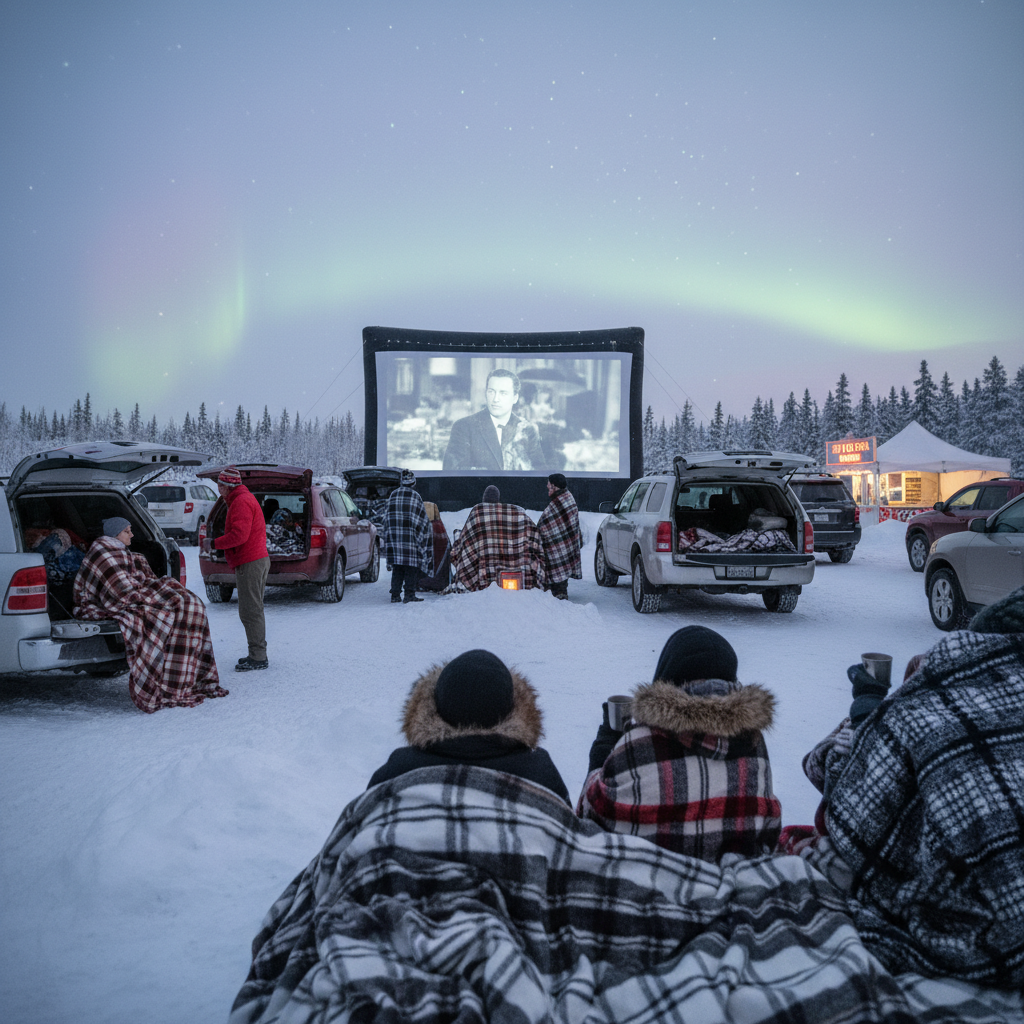
Soon after, a small team in Iqaluit followed suit. They parked snowmobiles beside pickups, laid blankets across windshields, and screened Nanook of the North as their opening film — part homage, part statement of pride. The sound came through FM radio, the image projected onto a snow-white wall. People laughed, cried, stayed until the projector froze.
The effort spread like fire in cold air. Fort Simpson, Yellowknife, Inuvik — every town made it its own. Each screen told the same story: that even in the most remote corners of the country, connection finds a way.
Where Light Never Dies
Watching a movie in the North feels different. The light never truly leaves, and neither does the stillness. Around midnight, the air hums faintly, and everything glows — mountains, rivers, faces, the edges of the screen.
Children curl up inside trucks, faces pressed to foggy glass. Adults sip coffee from thermoses, shoulders draped in sealskin or fleece. The sound of the film mingles with the wind moving across the flats.
“You don’t come here for the picture quality,” says Yukoner Clara Jones with a grin. “You come for the quiet.”
When the final scene fades, there’s no rush to leave. The crowd stays seated, letting the light do what it’s always done — linger.
The Land as Cinema
In Northern Canada, nature has always been the greatest screen. The way the aurora dances through a beam of projection light feels almost intentional, like two old storytellers meeting again.
Every showing feels like collaboration — man and land, sound and silence, cold and warmth. At Polar View Drive-In near Yellowknife, ravens perch on the screen’s edge, silhouetted by the film’s glow. People laugh and point. No one tells them to leave.
The revival here comes with a uniquely northern flavor:
- Hot bannock and muskox stew at concession stands
- Solar-powered projectors adapted to sub-zero temperatures
- Short films by Inuit and Dene creators introducing each showing
- Community radio DJs announcing the next week’s lineup between folk songs
In the Yukon, the evening always opens with a local film or poem. “Our nights are short,” says poet and curator Liam Tagak. “But the stories last longer.”
Silence That Holds People Together
The most striking thing about these nights isn’t the movie. It’s the silence — a silence that feels full, protective, alive.
In Iqaluit, snow begins to fall during a screening. Nobody leaves. They sit, bundled and wordless, watching flakes drift across the beam of light. The film pauses briefly, then resumes. A few people cheer softly. The sound echoes against ice and open air.
That’s what connection looks like here — not noise or spectacle, but endurance.
When the Light Fades, the Glow Remains
When the show ends, the projectors dim, but the horizon still shimmers. The people stay for a few minutes, just to watch the northern sky — pink and gold and endlessly bright.
Engines start, headlights stretch across gravel, and slowly the field empties. In their rearview mirrors, the last image they see isn’t the screen, but the sky itself — vast, eternal, quietly human.
Northern Canada’s drive-in revival is more than nostalgia. It’s a declaration: that even in the most distant places, the love of story runs deep; that warmth isn’t measured by degrees, but by presence.
So if you’re ever far north and see a flicker against the snow, follow it.
You’ll find a crowd of people, wrapped in silence, sharing warmth beneath a sun that never truly sets — proof that light, like community, always finds a way to stay.