- calendar_today August 20, 2025
The team from Carnegie Mellon University developed LegoGPT, which translates basic text instructions into real-world buildable Lego constructions. This system stands out because it creates Lego designs from text inputs and confirms that these models can be constructed with either human or robotic help.
LegoGPT operates on the fundamental capability to understand textual descriptions like “a streamlined, elongated vessel” or “a classic-style car with a prominent front grille” and transform them into accurate sequences of Lego brick positions that lead to structurally stable constructions. The model’s development occurred through the training of an autoregressive large language model using a dataset that included over 47,000 stable Lego designs accompanied by descriptive captions produced by OpenAI’s GPT-4o. The training process allows the AI to understand how language corresponds with stable Lego arrangements so it can determine which brick should be placed next to ensure structural stability.
The Inner Workings of LegoGPT
LegoGPT uses foundational concepts from large language models such as ChatGPT while shifting its focus from generating the next word to predicting the next brick in a design. The researchers enhanced Meta’s LLaMA-3.2-1 B-Instruct language model through fine-tuning and integrated a specialized software tool that uses mathematical models to simulate gravitational forces and structural integrity to validate the physical stability of produced designs. The “physics-aware rollback” mechanism in LegoGPT enables the system to detect structural vulnerabilities during design creation by backtracking through brick placements to find better alternatives, which improved stability from 24 percent to 98.8 percent. The AI constructs Lego brick sequences that maintain precise positioning while preventing collisions and keeping within defined building boundaries. The mathematical models verify that a completed design maintains its upright position without collapsing.
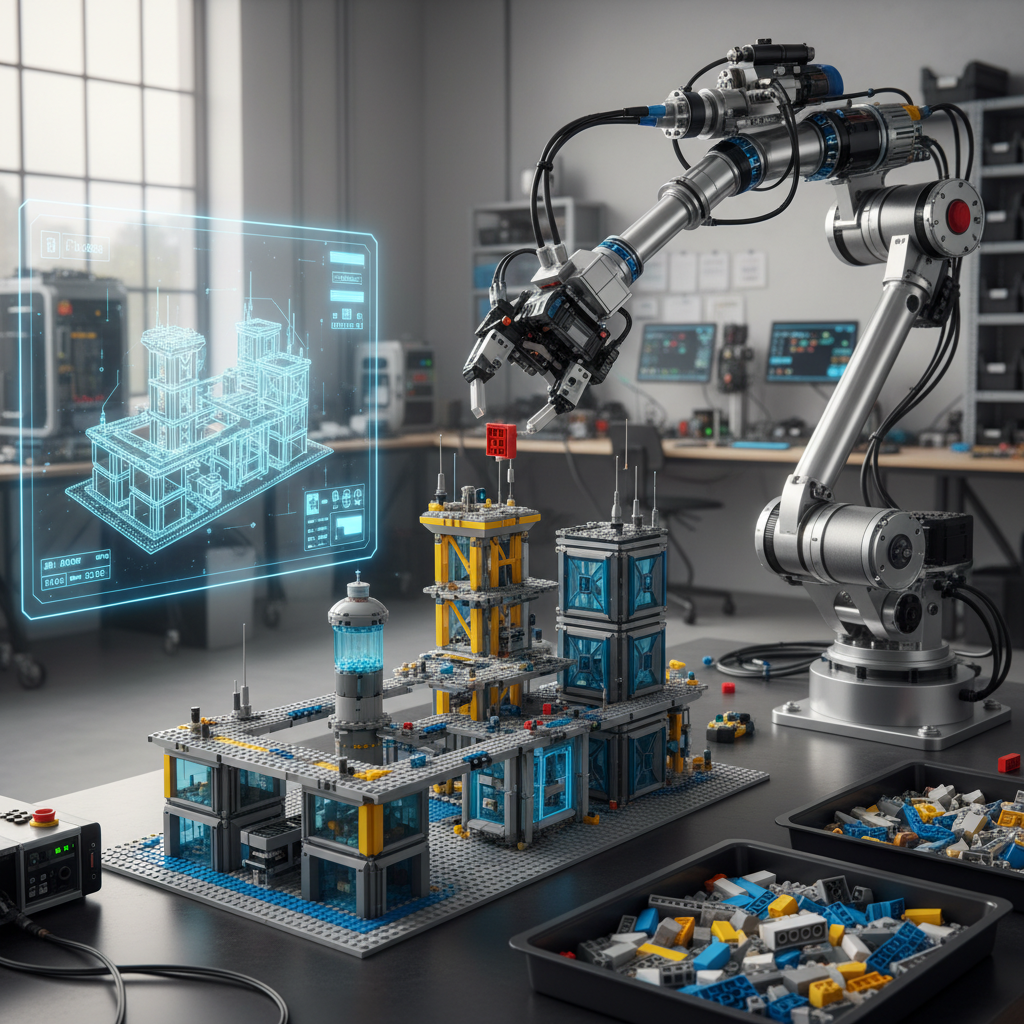
The researchers tested the practicality of LegoGPT designs through stringent robotic assemblies and human construction experiments. The researchers employed a complex dual-robot arm system with force sensors, which enabled them to construct AI-generated models based on pre-determined brick sequences. Human testers joined the evaluation process by physically constructing some of the AI-generated designs, which proved that LegoGPT delivers realistic and structurally sound Lego models in line with the original text prompts. Through these experiments, we proved that the system can convert written descriptions into physical Lego constructions that accurately mirror the intended design and maintain structural strength suitable for assembly in reality. The ability of both automated machines and human builders to construct these structures demonstrates the functional reliability and strength of the instructions generated by AI.
LegoGPT stands out from other AI systems in 3D creation such as LLaMA-Mesh because it maintains a constant focus on building structural integrity. According to team evaluations their method consistently produced a much higher percentage of stable structures unlike other approaches which tend to emphasize visual details at the expense of structural practicality. The LegoGPT system functions inside a fixed building environment measuring 20×20×20 units and uses only eight standard types of Lego bricks.
The research team recognizes current constraints while proposing future enhancements to broaden LegoGPT’s design capabilities through extended structural dimensions and additional brick types such as slopes and tiles. The upcoming expansion of LegoGPT will probably require additional improvements to both the AI model and its physics simulation elements to manage the heightened complexity. LegoGPT’s achievement of merging language comprehension with physics simulation represents a major advancement in artificial intelligence applications for constructing physical models.
The Broader Implications of LegoGPT
LegoGPT’s capabilities suggest possible applications beyond just creating Lego models. The translation feature of LegoGPT, which converts abstract textual instructions into stable, buildable structures, demonstrates potential uses across architecture and engineering disciplines. Envision a future where designers can verbally describe structural components or robotic assemblies, and AI systems can then produce detailed, buildable instructions that include stability assessments. The integration of AI systems could lead to more efficient design workflows by minimizing mistakes and making advanced physical object creation accessible to a wider audience. The development of AI systems like LegoGPT promises to transform design and manufacturing processes across industries by making the connection between digital design and physical creation nearly seamless.
LegoGPT marks an important advancement in AI-driven design evolution by producing structures that are both visually pleasing and structurally viable through text-based generation. The emphasis on stability and constructability principles establishes a new AI standard for physical creation while suggesting a future where AI becomes crucial in turning digital designs into reality.