- calendar_today August 16, 2025
.
This is a small moon, but a big discovery. The key is that Webb is really changing the game for science, letting us see far beyond what Voyager or Hubble, even at their best, have been able to do.” — Maryame El Moutamid, an astronomer
El Moutamid is also a principal investigator of one of Webb’s science programs focusing on the rings and inner moons of Uranus. “The discovery of this hidden moon around Uranus is a great example of how Webb is opening up the system to provide new knowledge far beyond previous missions,” El Moutamid said.
Webb Reveals Mystery Moon’s Details
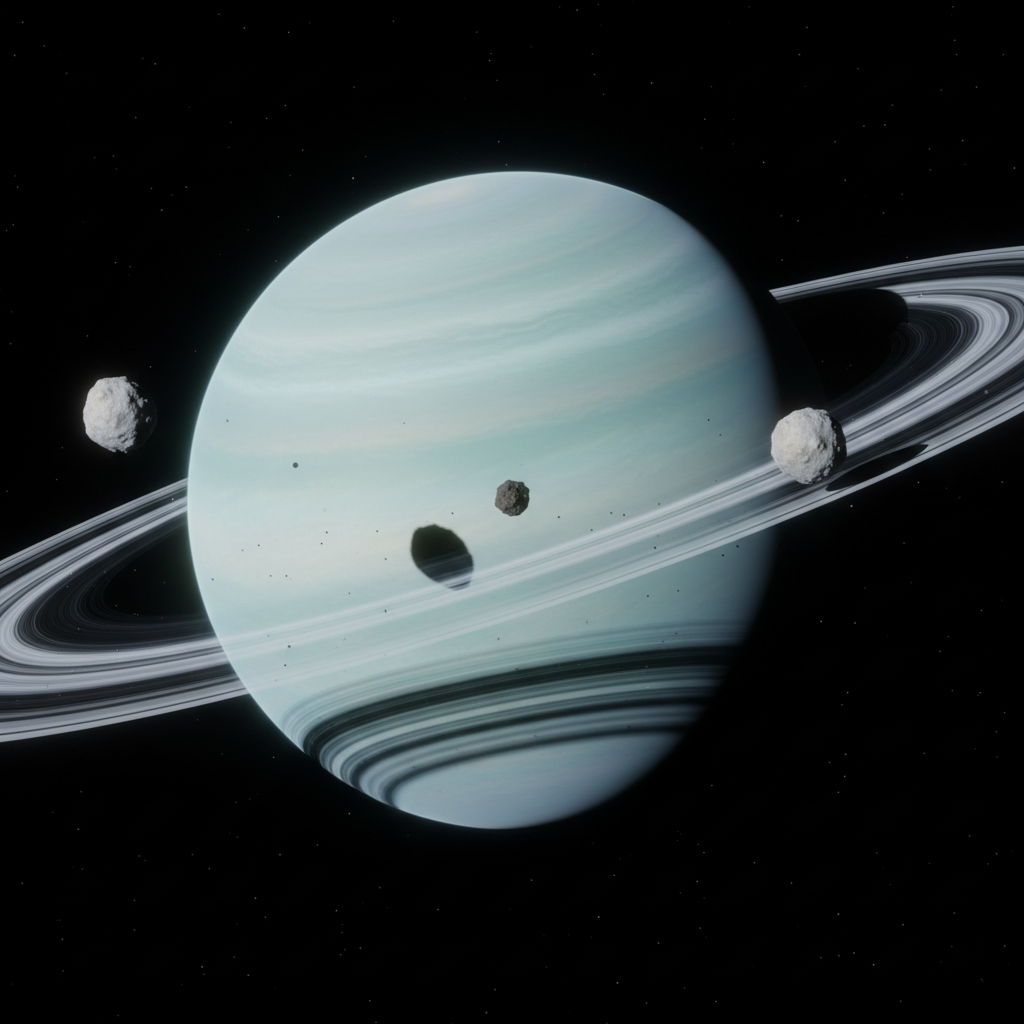
The small moon has a provisional designation S/2025 U1. It orbits Uranus’ equatorial plane in a nearly circular orbit 35,000 miles (56,000 kilometers) from the planet’s center, sandwiched between the two known moons Ophelia —just outside Uranus’ main ring system— and Bianca. The orbit indicates the moon could have formed at its current location.
Astronomers did not discover the small moon during previous spacecraft missions or with ground-based telescopes, likely because it is so dark, small, and moves so quickly across the sky. Its orbit trails the fast-moving planet Uranus and was very difficult to pick out of the planet’s glare. The best way to see it was to catch the infrared light that the object reflects. Webb is doing just that, and the telescope’s imaging has already shown evidence of Uranus’ rings, weather, and atmosphere.
Unlocking Uranus’ Mysterious Family
Adding another small moon to the count is one thing, but it also raises new questions about Uranus’ mysterious rings and moons. Scientists think that S/2025 U1 may have formed from the same event that created one or more of the rings of Uranus. The dark moon and inner rings may therefore have a common origin, and the event that created S/2025 U1 could have also produced fragments that became part of Uranus’ rings.
“We think it could have formed from an event that happened long ago,” said El Moutamid. “The discovery raises questions about how many other small moons remain undiscovered around Uranus and what interactions might be going on between them and its rings.”
At present, Uranus is known to have five big moons, Miranda, Ariel, Umbriel, Titania, and Oberon, as well as numerous smaller moons. The newly discovered object is the 14th identified in its small-moon family in the inner system. No other planet has so many small inner moons so closely packed together, and that is a mystery. Their orbits could cross, but somehow, they don’t. Astronomers think they could be shepherds, protecting Uranus’ narrow rings.
Scott Sheppard, an astronomer at the Carnegie Institution for Science who was not involved in the new research but helped discover a Uranus moon in 2024, described the moon as a “very exciting” find. “The reason why this one is so interesting is because the object is in a very close association with the Uranus inner ring system,” Sheppard said. “It’s very significant that we can pick it up even at these small sizes with Webb’s sensitivity.”
Researchers at the SETI Institute, including Matthew Tiscareno, a co-principal investigator in the Webb Uranus project, noted the moon discovery is helping to erase the boundary between Uranus’ moons and its rings. “Their very complex inter-relationships are a hint of a chaotic history,” he said. The latest discovery also surprised him because the new moon is even fainter and smaller than the smallest known Uranian inner moons yet to be discovered.
History of Moon Discoveries Orbiting Uranus
Discovery of Uranus’ moons has come in waves. Before Voyager 2’s historic 1986 flyby, only five moons had been discovered—the biggest five visible from Earth, one as far back as 1787. Voyager 2 would come to discover 10 more small moons as it flew by Uranus. These new moons were small, measuring between 16 and 96 miles (26 and 154 kilometers) wide. More moons were discovered later, this time with ground-based telescopes and the Hubble Space Telescope. 13 small moons orbiting Uranus have been identified that are no larger than 8 to 10 miles (12 to 16 kilometers) across and as dark as asphalt. The inner moons may be different in composition, made of ice and rock, while outer moons orbiting the planet beyond Oberon may be captured asteroids.
NASA’s next large planetary mission could be a Uranus Orbiter and Probe. The planetary decadal survey published in 2022 by the National Academies of Sciences, Engineering, and Medicine suggested the agency do just that next. It could launch as early as the 2030s. Funding for such a mission is still in question as NASA and Congress haggle over the agency’s budget. If realized, a Uranus Orbiter and Probe mission would explore Uranus’ tilted rotation, its complex magnetic field, the dynamics of its atmosphere, and moons, which may harbor icy ocean worlds.
Sheppard said that there are likely other small moons on Uranus as small as a few kilometers in diameter that could be discovered by long-exposure Webb imaging and potential future spacecraft missions. El Moutamid and her team will continue to refine the orbit and search for other unseen moons.
“There’s much to discover. This is just the first step of what Webb is going to be able to reveal about Uranus’ system of rings and moons,” El Moutamid said. “Discovering a new moon around Uranus helps us understand how its strange system formed, also shines a light on its rings, and sets the stage for future missions like NASA’s Uranus Orbiter and Probe.”