- calendar_today August 12, 2025
.
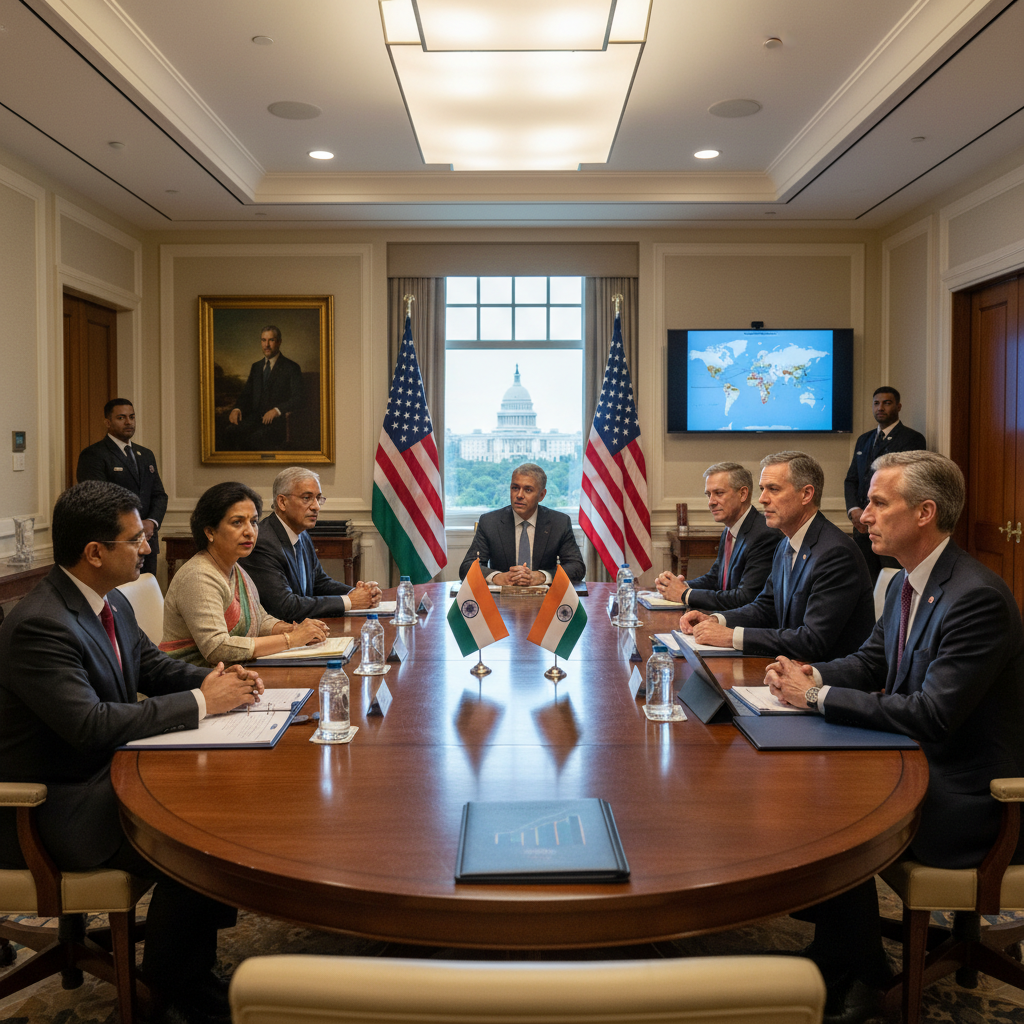
Washington and New Delhi have been fostering what had been for more than 20 years a relationship the administration of U.S. President Joe Biden described as one of the most productive post–Cold War strategic partnerships. For all the years of diplomatic engagement and defense trade, ties between the world’s oldest and largest democracies are now hitting a breaking point as trust gives way to tariffs, oil purchases, and political posturing.
Evan Feigenbaum, South Asia chair at the Carnegie Endowment for International Peace, minced no words about what was going on. “We’re in a situation in the U.S.-India relationship where the premises and assumptions of the last 25 years, and many of them that this administration worked very hard to build up, including the president in his first term, have just come completely unraveled,” Feigenbaum said in an interview with Foreign Policy. “The trust is gone.”
Things got especially rocky between the White House and India’s ruling Bharatiya Janata Party (BJP) government in May, when Trump announced a wide-ranging tariff on Indian goods, which has already gone up to 25 percent, starting August 27, it will increase to 50 percent, for New Delhi’s refusal to give up its purchases of Russian crude oil despite the war in Ukraine. Rather than pressure India into curbing its energy trade with Moscow, the U.S. tariffs appear to have pushed India even closer to Russia and Beijing.
National security adviser Ajit Doval made a highly publicized visit to Moscow in recent weeks, Foreign Minister Subrahmanyam Jaishankar made his way to Russia for top-level meetings, while Chinese Foreign Minister Wang Yi concluded a meeting of his own in New Delhi. Modi, who hasn’t visited China since 2015, is also preparing to make his first trip to Beijing in over seven years, and Russian President Vladimir Putin is expected to welcome him in Moscow by the end of this year. The analysts also say it’s not just symbolic.
In India, public opinion is also hardening. “The Indians are signaling very clearly that they view that as interference in India’s foreign policy, and they are not going to put up with it,” Feigenbaum said, referring to public and private signals New Delhi has been sending Washington.
On the other hand, despite an early reticence in the war’s early days, state-run refiners took the bait of discounts of six to seven percent and have resumed oil imports from Russia. For its part, Russia, which is looking to reorient oil exports after a more than year-long Western boycott, has pounced. Deputy Prime Minister Denis Manturov said on state TV Moscow “will ship oil, oil products, thermal and coking coal” to India, as well as seeing “potential for the export of Russian LNG.”
Factors
It’s not just the Trump tariffs, of course, although that is a significant factor. Michael Kugelman, a South Asia analyst in Washington with the Wilson Center, said some of the change in India’s alignment is driven by domestic imperatives as Modi looks to consolidate his Hindu nationalist credentials at home. “We’ve seen indications for almost a year of India wanting to ease tensions with China and strengthen relations, mainly for economic reasons. But the Trump administration’s policies have made India want to move even more quickly,” Kugelman said.
Moreover, while much of New Delhi’s outreach to Russia and China can be seen as grandstanding, there is some permanence to it. Feigenbaum said, “India is going to double down on some aspects of its economic and defense relationship with Russia — and those parts are not performative.”
Indeed, as India had moved before the war to decrease its dependence on Russian weapons, its government has diversified its orders and purchases to include U.S., French, and Israeli-made defense systems. “But since that invasion began, energy trade has taken off like never before,” Kugelman said. “This is a signal from India that the U.S. can’t be trusted, whereas Russia can — because Russia is always going to be there for India no matter what.”
Modi has also been capitalizing on his international pugnacity to play to a domestic audience at home, painting himself as a defender of India’s national sovereignty. He’s also talking about his priority in protecting the livelihoods of farmers, small business owners, and young workers, which has particular domestic political resonance. Kugelman noted that India has already given in on a host of issues, from tariff reductions to sending back workers.
“In order not to look weak, Modi needs to stand up. Because of those concessions, India needs to be careful about signaling further willingness to bend. This is one reason there was no trade deal — Modi put his foot down,” Kugelman said.
In the U.S., tempers are flaring. Peter Navarro, a former White House trade adviser under Trump who wrote in the Financial Times that India’s oil purchases are “opportunistic” and “deeply corrosive,” has called for the U.S. to continue slapping tariffs on India “right up until the day she discontinues this outrageous behavior.” He wrote that tariffs had to be used to hurt India “where it hurts — its access to U.S. markets — even as it seeks to cut off the financial lifeline it has extended to Russia’s war effort.”